

Most of us are familiar with “lie detector” tests from TV and the movies: Dramatic scenes of a suspect hooked up to a polygraph machine are a staple of police and crime shows. In reality, the first polygraph machine was developed more than a century ago and polygraph tests are still used by many U.S. law enforcement and intelligence agencies. Despite this ubiquity, scientific evidence suggests that polygraph tests are not a reliable and valid way to detect deception, and their use in legal proceedings has long been restricted in many states.
American Psychological Association. (2025, October 14). Do “lie detectors” work? What psychological science says about polygraphs. https://www.apa.org/topics/cognitive-neuroscience/polygraph
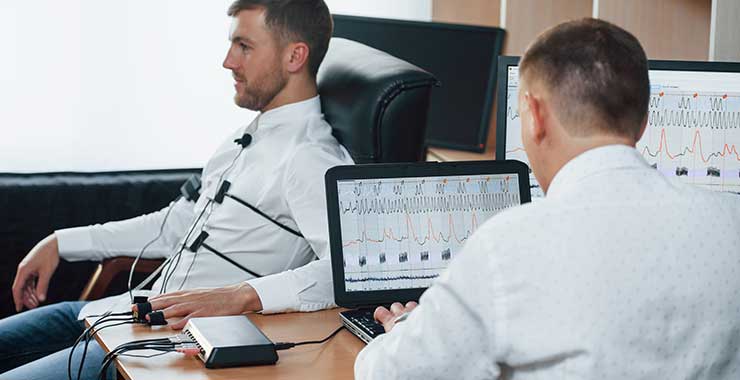
What are polygraph tests and how do they work?
Polygraph machines purport to detect lies by measuring physical changes thought to be associated with lying, such as changes in heart rate, blood pressure, respiration, perspiration, and skin conductivity. During a polygraph test, an interviewer or interrogator asks the subject a series of questions designed to elicit truthful answers and lies, then measures physiological changes in response to the questions.
What are the different forms of polygraph tests?
The most widely used polygraph method is the comparison-question technique (CQT), first developed in 1947. The CQT compares subjects’ physiological responses to three different types of questions: Those relevant to an investigation (e.g. “Did you kill your wife?”); neutral (irrelevant) questions designed to get a baseline pattern of physiological responses; and questions about past behavior that are not relevant to the investigation but are designed to elicit lies (e.g. “Have you ever betrayed someone you love?”). The idea is that a guilty person will have a stronger response to the investigation-relevant questions, while an innocent person will have a stronger response to the control questions designed to elicit lies.
Another polygraph method is the concealed-information technique (CIT), also known as the guilty knowledge test. This test assumes that only someone guilty will show arousal when lying about a fact that is not known to the public, such as the specific murder weapon used in a crime.
How are polygraph tests used?
Polygraph tests have historically been used in criminal investigations as well as in employment screening for jobs and security clearances.
Although a 1988 law prohibits most private-sector employers from using polygraphs, polygraph testing is still used in employment screening and testing by federal, state, and local law enforcement agencies.
In addition, law enforcement agencies use polygraph tests in criminal cases, to verify the truthfulness of suspects, witnesses, and complainants; and sex offender treatment programs use polygraph tests to evaluate treatment progress and compliance.
About half of U.S. states allow polygraph evidence to be used in court cases when both parties agree to it, and one state (New Mexico) allows it without both parties agreeing.
How accurate and reliable are polygraph tests?
Reviews of decades of scientific research suggest that polygraph tests are not reliable or accurate enough to be used in most forensic, legal or employment settings.
Although lying can cause the physiological responses measured by polygraph machines—such as sweating and increased heart rate—those same changes can occur even when people are not lying, for example when they are nervous. So, while polygraph tests might be able to detect deceit, they also may have a high error rate.
A landmark 2003 National Academy of Sciences report found that CQT polygraph testing could identify lies about 70% of the time. However, its false-positive error rate—the rate at which it misidentified a truth as a lie—was unknown. Overall, the report concluded that the scientific basis of the CQT polygraph test was weak and that much of the research on polygraph accuracy was of low quality (National Research Council, 2003).
A 2019 review of the scientific literature since then found that the quality of research has changed little in the years since the report was released, and that the report’s conclusions still stood (Iacono & Ben-Shakhar, 2019).
An industry meta-analysis found an accuracy rate of 89% for polygraph tests (American Polygraph Association, 2011), however critics point out that the research was not peer-reviewed or conducted by independent researchers.
Overall, while polygraph testing remains in widespread use, most psychologists and other scientists agree that there is little basis for the validity of polygraph tests.
References
American Polygraph Association. (2011). Meta-analytic survey of criterion accuracy of validated polygraph techniques. Polygraph, 40, 194–305.
Iacono, W. G., & Ben-Shakhar, G. (2019). Current status of forensic lie detection with the comparison question technique: An update of the 2003 National Academy of Sciences report on polygraph testing. Law and Human Behavior, 43(1), 86–98. https://doi.org/10.1037/lhb0000307
National Research Council (2003). The Polygraph and Lie Detection. Committee to Review the Scientific Evidence on the Polygraph. Division of Behavioral and Social Sciences and Education. Washington, DC: The National Academies Press.